Bible Translation Copyright and Permissions: What Christian Publishers Need to Know
Bible translations have different copyright and quotation requirements. Learn how Christian publishers can manage permissions, attribution, verse limits, public-domain translations, and Scripture verification before publication.
Quoting Scripture in a Christian publication may seem straightforward.
The Bible is ancient. The English translation being quoted may not be.
Most modern Bible translations are copyrighted works with specific requirements governing quotation limits, attribution, commercial publishing, digital use, audio, commentary, and other forms of reproduction.
For Christian publishers, that makes Scripture more than an editorial element. When copyrighted translations are used, Scripture is also a rights-managed component of the publication.
The question is not simply:
Can we quote Scripture?
The better questions are:
Which translation are we using, what are its current permissions requirements, and does this particular publication fall within them?
Those questions matter for devotionals, Bible studies, Christian nonfiction, workbooks, journals, children’s books, sermon collections, educational resources, audiobooks, and other publications containing Scripture.
The requirements vary by translation and can change. For substantial quotation, unusual uses, licensing questions, or uncertainty, publishers should consult the translation rights holder’s current permissions policy and obtain qualified legal advice when appropriate.
Modern Bible Translations Have Their Own Copyright Rules
A modern Bible translation is not simply a mechanical copy of ancient Hebrew, Aramaic, and Greek texts.
Translation teams make extensive decisions involving vocabulary, syntax, structure, expression, and interpretation of the source languages.
The resulting English wording can be protected by copyright.
That is why permission to quote one translation does not automatically provide permission to quote another.
Translations such as the:
- New International Version (NIV)
- English Standard Version (ESV)
- New Living Translation (NLT)
- New King James Version (NKJV)
- New American Standard Bible (NASB)
- Christian Standard Bible (CSB)
have their own copyright owners and usage requirements.
Some policies have similarities.
They are not interchangeable.
Before publication, verify the current policy for the exact translation being used.
How Much Scripture Can You Quote Without Written Permission?
Several major translation rights holders allow limited Scripture quotation without requiring an individual written permission request.
But those allowances come with conditions.
For example, current standard guidelines for several widely used translations permit hundreds of verses to be quoted without individual written permission when additional requirements are satisfied.
The NIV, NLT, and ESV each currently have standard provisions that can allow quotation of up to 500 verses in qualifying uses.
That does not create a universal 500-verse rule for Bible publishing.
Additional restrictions can involve:
- the percentage of the publication consisting of Scripture
- the amount quoted from an individual biblical book
- reproduction of an entire biblical book
- whether the publication is a commentary or Bible-reference work
- print versus digital use
- audio use
- commercial use
- required copyright notices
- other special-use conditions
A publication can therefore remain below a numerical verse limit and still require permission.
The correct publishing practice is not to memorize a number.
Check the current policy for the translation and the type of publication being produced.
Percentage Limits Matter as Much as Verse Counts
Verse count is only part of the calculation.
Suppose a short devotional booklet contains 120 quoted verses.
That sounds comfortably below a 500-verse allowance.
But imagine those verses constitute 30 percent of the finished publication.
Depending on the translation’s policy, the project may no longer fall within its standard quotation allowance.
That means publishers should track two different measurements:
How many verses are being quoted?
and:
How much of the finished publication consists of Scripture?
Both can affect whether permission is required.
This becomes especially important with short books, Scripture journals, devotionals, Bible studies, and other publications in which biblical text represents a substantial percentage of the finished content.
Devotionals Can Accumulate Scripture Quickly
A single devotional entry might contain only one or two verses.
That does not appear significant when reviewing one entry.
Across a 30-day, 90-day, or 365-day devotional, however, Scripture usage can accumulate rapidly.
The same issue can occur with Bible studies and workbooks.
Instead of waiting until the manuscript is finished, begin tracking Scripture during production.
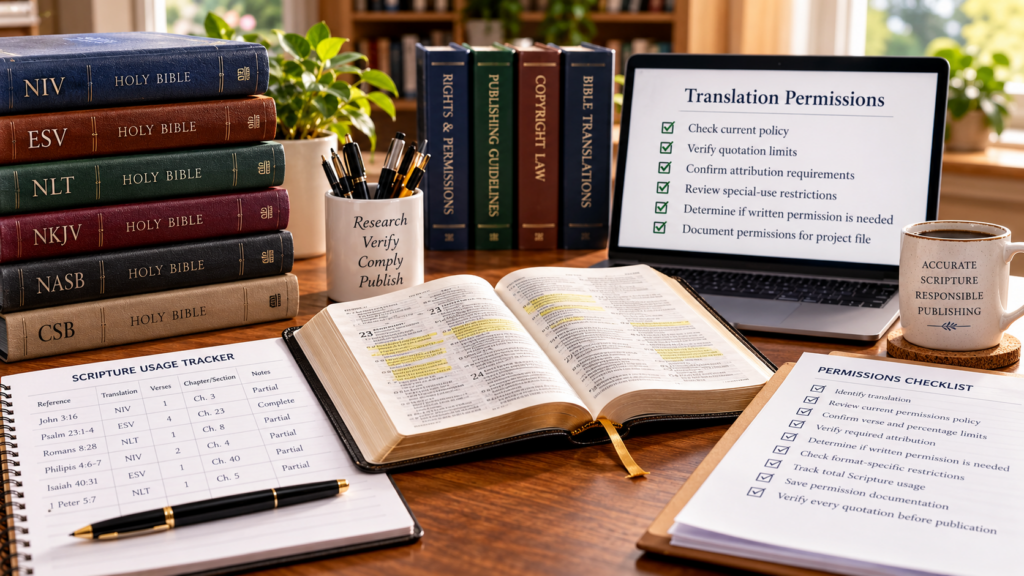
A basic Scripture inventory can record:
- Scripture reference
- translation
- number of verses quoted
- whether the quotation is complete or partial
- chapter or devotional in which it appears
- cumulative verse count
This turns permissions review into part of the publishing workflow rather than an emergency discovered immediately before release.
It can also uncover inconsistencies, such as accidentally quoting the same passage from different translations in different parts of the manuscript.
Attribution May Be Required Even When Written Permission Is Not
Being within a translation’s standard quotation allowance does not necessarily mean its text can be reproduced without attribution.
Translation rights holders commonly specify copyright and attribution language that must accompany published use.
Depending on the translation and publication, that information may belong on the copyright page, title page, or another designated location.
When several translations appear in one publication, individual quotations may also need appropriate translation abbreviations.
For example:
NIV
ESV
NLT
The publisher should use the attribution language required by the translation rights holder rather than inventing substitute wording.
This is an important distinction:
No individual permission request required does not necessarily mean no copyright notice required.
Treat Scripture Permissions as a Publishing Record
For Scripture-heavy publications, publishers should create a dedicated permissions record.
Record information such as:
- translation
- rights holder
- official permissions policy
- date the policy was checked
- standard quotation allowance
- percentage restriction
- required attribution
- number of verses used
- special-use restrictions
- written permission or license received, when required
Save permission correspondence and license documentation with the book’s production files.
This record can become extremely valuable later.
A book may eventually be:
- revised
- expanded
- reprinted
- converted to an audiobook
- translated
- licensed
- republished
- incorporated into another product
A documented rights history makes those future decisions much easier than reconstructing the original permissions process years later.
Do Not Depend Only on a Printed Bible’s Copyright Page
The copyright page of a physical Bible can provide useful information.
It should not necessarily be the publisher’s only source when preparing a commercial publication.
Translation rights holders maintain permissions policies that may address:
- verse limits
- percentage limits
- complete-book restrictions
- required attribution
- print use
- eBook use
- websites
- audio
- artwork
- commercial products
- commentary
- Bible-reference works
- licensing requests
Policies can also change.
A printed Bible purchased years ago may not reflect the current requirements governing a new publishing project.
For a short article containing a few verses, compliance may be relatively simple.
For a 365-day devotional, Bible study workbook, commentary, Scripture journal, or other Scripture-heavy publication, a formal permissions review becomes much more important.
Commentary and Bible-Reference Works Need Special Attention
A Christian nonfiction book that quotes Scripture to support the author’s discussion is not necessarily treated the same way as a biblical commentary or reference work.
Some translation policies impose additional requirements or exclude certain commentary and Bible-reference uses from their ordinary no-permission quotation allowances.
That means the nature of the publication matters, not merely its verse count.
A project could quote relatively few verses and still require additional permission because Scripture functions as a primary reference text rather than supporting original material.
Publishers developing:
- commentaries
- study Bibles
- Scripture-reference books
- Bible dictionaries
- verse-by-verse studies
- other Scripture-intensive reference works
should investigate the applicable policy early in development.
Do not wait until editing and design are complete to discover that the planned Scripture use requires a separate license.
When Should a Publisher Request Written Permission?
Written permission may be necessary when a project falls outside the translation rights holder’s standard quotation guidelines.
Situations that warrant additional investigation can include:
- exceeding the standard verse allowance
- exceeding the permitted percentage of the publication
- reproducing an entire biblical book
- producing a commentary or Bible-reference work
- extensive Scripture use in artwork or commercial products
- certain digital or audio uses
- uses specifically excluded from standard permissions
- any project outside the rights holder’s published guidelines
A permissions request may require information such as:
- publication title
- author
- publisher or imprint
- expected publication date
- format
- anticipated print run
- distribution
- number of verses
- percentage of Scripture in the publication
- commercial status
- passages being reproduced
This is another reason to address permissions early.
Discovering a licensing issue after a book has been fully designed, uploaded, or scheduled for release can create avoidable production delays.
Public-Domain Bible Translations Can Simplify Permissions
Some Bible translations are in the public domain in the United States.
That can simplify the copyright permissions process because ordinary copyright permission is generally not required to reproduce the biblical text itself.
Examples include the American Standard Version of 1901 and the World English Bible.
The King James Version is also generally treated as public domain in the United States, although its international situation requires additional attention.
Public-domain status can be useful when a publishing project requires extensive Scripture quotation.
But publishers still need to distinguish the underlying biblical text from additional copyrighted material appearing in a particular edition.
A modern study Bible using public-domain Scripture may contain separately protected:
- study notes
- maps
- introductions
- commentary
- illustrations
- charts
- design elements
Public-domain Scripture does not place all surrounding editorial material in the public domain.
The King James Version Has an International Complication
The King James Version occupies an unusual position.
In the United States, its biblical text is generally treated as public domain.
In the United Kingdom, the Authorized Version is subject to special rights administered under Crown privilege.
That distinction matters for publishers distributing internationally.
A publication intended solely for the United States may face a different rights situation from one distributed across multiple countries.
Copyright and related publication rights are jurisdiction-specific.
Do not assume that because a translation is unrestricted in one country, it is unrestricted everywhere.
The World English Bible Is Designed for Open Use
The World English Bible provides another option for publishers who need contemporary English Scripture without the ordinary copyright restrictions associated with many modern translations.
The biblical text has been dedicated to the public domain and can be copied, quoted, published, distributed, and sold.
There is, however, an important distinction involving its name.
World English Bible identifies the official text.
If the biblical text is altered, publishers should not continue presenting the modified version as though it were the official World English Bible.
This protects readers from confusing altered wording with the established translation.
The broader lesson applies beyond this particular translation:
Public-domain text still requires careful editorial identification.
Public Domain Should Not Be the Only Reason to Choose a Translation
Copyright convenience matters.
It should not be the only editorial consideration.
A Bible translation also needs to fit the:
- intended audience
- reading level
- theological or denominational context
- tone
- purpose of the publication
- established editorial standards
- consistency of a series or publishing line
A children’s devotional and an academic theological work may have very different translation requirements.
A publisher should not compromise the editorial purpose of a project simply to avoid permissions administration.
Translation selection is both a rights decision and an editorial decision.
Paraphrasing Scripture Is Not a Shortcut Around Copyright
Writers sometimes assume that lightly changing the wording of a copyrighted Bible translation eliminates the permissions issue.
That is not a sound publishing practice.
There is a meaningful difference between:
an author’s own summary or paraphrase of a biblical idea
and:
slightly rewriting the distinctive wording of a copyrighted translation.
Changing a few words does not automatically resolve the underlying copyright question.
It can also create an editorial problem.
Readers should be able to distinguish among:
- direct quotation
- paraphrase
- summary
- commentary
- interpretation
Do not place quotation marks around wording that is not actually quoted from the translation identified.
And do not present lightly modified translation wording as though it were an original paraphrase merely to avoid dealing with permissions.
Copyright Compliance and Scripture Accuracy Are Different Requirements
This distinction is especially important for Christian publishers.
A Scripture quotation can satisfy copyright requirements and still be wrong.
The publisher may have permission to use a translation but accidentally publish:
- incorrect wording
- the wrong verse number
- omitted words
- altered punctuation
- blended wording from multiple translations
- the wrong translation abbreviation
The reverse is also possible.
A quotation can reproduce the biblical text perfectly while failing to satisfy the translation owner’s copyright or attribution requirements.
That means Scripture needs two separate forms of quality control:
Rights verification: Are we permitted to use this text in this way?
Text verification: Have we quoted and identified the Scripture accurately?
Neither replaces the other.
Verify Every Scripture Quotation Before Publication
Every direct Scripture quotation should be checked against the actual translation being cited.
Verify:
- biblical book
- chapter
- verse
- exact wording
- punctuation
- translation
- attribution
Do not rely on memory.
Do not rely solely on a search-result snippet.
And do not rely on AI-generated Scripture quotations without verification against an authoritative source for the translation.
AI systems can produce blended wording, incorrect references, or plausible-sounding quotations that do not actually appear in the identified translation.
For Christian publishers, Scripture verification should be treated as a required pre-publication quality-control step.
Build Scripture Review Into the Production Workflow
The strongest approach is to make Scripture permissions and verification part of the normal publishing process.
A practical workflow can look like this:
- Identify every Bible translation used.
- Check the current permissions policy for each translation.
- Record applicable quotation and percentage restrictions.
- Track Scripture usage throughout the manuscript.
- Request written permission when the project falls outside standard allowances.
- Insert the required copyright and attribution language.
- Verify every direct quotation against the cited translation.
- Review the finished publication for translation consistency and attribution.
- Archive permission records with the final production files.
This is far safer than treating Scripture permissions as something to investigate after the book is already formatted.
Frequently Asked Questions
Are all Bible translations copyrighted?
No. Many modern translations are copyrighted, while some older translations and intentionally open translations are in the public domain. Publishers should verify the status of the exact translation they intend to use.
Can I quote the NIV without obtaining individual permission?
Often, yes, when the publication remains within Biblica’s current standard quotation conditions. Those conditions include limits involving verse count, percentage of the publication, complete biblical books, attribution, and the nature of the use.
Can I quote the NLT in a devotional?
The NLT provides standard quotation permissions for qualifying print and eBook uses subject to its current limits and required attribution. Some uses require additional permission, so a Scripture-heavy devotional should be evaluated against the complete current policy.
Can I quote the ESV in a Bible study?
Potentially, but the nature and extent of the Bible study matter. The ESV’s standard guidelines include verse, percentage, and biblical-book limitations, and commentary or Bible-reference uses can be subject to additional requirements.
Is the KJV public domain?
The King James Version is generally treated as public domain in the United States. Its status in the United Kingdom is different because of special rights associated with the Authorized Version. International publishers should check the requirements for the territories in which they distribute.
Is the World English Bible free to use?
The World English Bible text is in the public domain. Publishers should still follow the requirements surrounding identification of the official text, particularly if making alterations.
Do I need permission if I quote only a few verses?
Not necessarily, but verse count is only one consideration. Translation, publication type, percentage of the work, attribution, format, and special-use provisions can also matter.
Does attribution replace permission?
No. Attribution and permission are separate issues. A publication can provide proper attribution and still require written permission if the use exceeds the translation’s standard allowance.
Should permissions be checked before or after the manuscript is written?
Before or during writing is preferable when Scripture will be a substantial part of the publication. Early review can prevent significant editing, licensing, and production problems later.
Treat Scripture as Both Sacred Text and Publishing Content
Bible translation copyright does not need to be intimidating.
It does need to be managed deliberately.
Identify the translation.
Check the current permissions policy.
Track how much Scripture the publication uses.
Obtain permission when necessary.
Use the required attribution.
Verify every quotation against the actual biblical text.
Preserve the documentation with the publishing records.
That process protects the publisher, but it serves a larger purpose as well.
Christian publishing carries a responsibility to handle Scripture accurately and transparently.
Good rights management and careful Scripture verification help fulfill that responsibility.