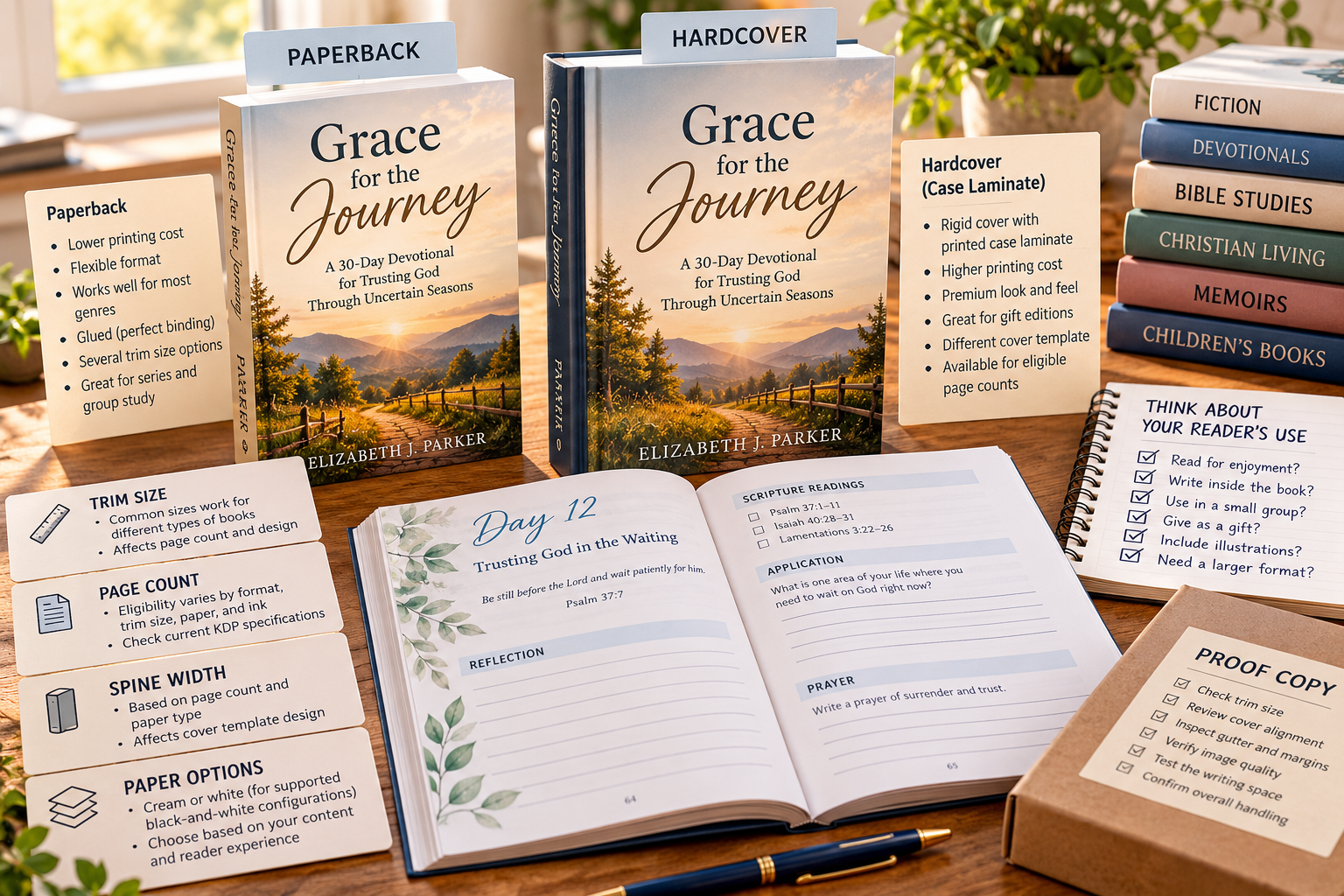
Book Distribution Beyond Amazon: Options for Christian Publishers
Amazon does not have to be your entire publishing strategy. Learn how Christian publishers can combine ebook, print, audiobook, bookstore, library, direct-sales, and ministry channels to create a stronger distribution system.

Amazon can remain an important sales channel without becoming the entire publishing strategy. Learn how Christian publishers can combine ebook, print, audiobook, library, bookstore, direct-sales, and ministry channels to build a distribution system around each book and its readers.
Amazon KDP has made independent publishing accessible to authors and small publishers around the world.
But publishing a book on Amazon is not the same as building a complete distribution strategy.
Christian books may reach readers through online retailers, bookstores, libraries, churches, Christian schools, homeschool communities, ministries, conferences, direct sales, international markets, and audiobook platforms.
No single distribution channel serves all of those audiences equally well.
The goal is not to place every book everywhere.
The goal is to determine where a particular book needs to be available and then build a distribution system capable of reaching those readers.
Amazon Is a Channel, Not a Complete Distribution Strategy
Amazon can play a major role in an independent publishing operation.
For many publishers, KDP offers a convenient way to distribute Kindle ebooks and print-on-demand paperbacks and hardcovers through Amazon.
That does not mean every edition of every book must depend exclusively on Amazon.
A Christian publisher producing devotionals, Bible studies, Christian nonfiction, fiction, children’s books, ministry resources, or educational materials may have audiences that extend well beyond a single marketplace.
Consider a few examples.
A Bible study workbook might be useful to churches, small groups, retreat ministries, and direct customers.
A Christian children’s book might have opportunities through schools, homeschool families, libraries, bookstores, and children’s ministries.
A devotional might sell through Amazon while also supporting direct sales, speaking events, conferences, churches, and an author’s existing audience.
A Christian fiction title may benefit from broad ebook availability across multiple retailers.
Distribution should follow the audience.
That principle is more useful than assuming every title needs exactly the same publishing strategy.
Understand KDP and KDP Select Before Going Wide
One of the most important distinctions in Amazon publishing is the difference between KDP and KDP Select.
Publishing an ebook through KDP does not by itself require the ebook to remain exclusive to Amazon.
KDP Select is the optional program that introduces digital exclusivity during its enrollment period.
An ebook enrolled in KDP Select becomes eligible for Kindle Unlimited and certain Amazon promotional opportunities, but the digital edition generally cannot be distributed through competing ebook retailers during that enrollment period.
Print and audiobook editions are treated separately from that ebook exclusivity requirement.
This creates an important strategic decision.
A publisher might decide that Kindle Unlimited and Amazon-focused ebook distribution make sense for one title.
Another title might benefit more from availability through Apple Books, Kobo, Barnes & Noble, libraries, and other ebook channels.
There is no universal answer.
The decision should be made title by title rather than automatically across an entire catalog.
Build Distribution Around Format and Audience
It is helpful to stop thinking of a book as one product.
A title may have several distinct editions:
- ebook
- paperback
- hardcover
- audiobook
- large-print edition
- workbook or companion resource
Those formats do not necessarily need the same distributor.
A publisher could use one service for the ebook, another for broader print distribution, another for audiobook distribution, and a fulfillment partner for direct print sales.
The question becomes:
What is the best route from each edition to the readers most likely to want it?
That is the foundation of a multi-channel distribution strategy.
Wide Ebook Distribution Extends Reach Beyond Kindle
Publishers who choose not to enroll an ebook in an exclusive program can make that edition available through additional retailers.
One approach is to upload directly to individual ebook stores.
Another is to use an ebook aggregator that distributes to multiple retailers and library channels from one publishing account.
Draft2Digital is one established option for publishers seeking broader digital distribution. It can simplify the administrative work involved in supplying ebooks to multiple storefronts rather than maintaining a separate publishing workflow for every retailer.
PublishDrive provides another distribution model and can be particularly relevant to publishers managing larger catalogs or multiple formats.
The choice between direct retailer relationships and aggregation involves tradeoffs.
Direct distribution may provide greater access to retailer-specific tools and account control.
Aggregation can simplify administration.
A publisher with two books may make a different choice from a publisher managing fifty titles.
Convenience, catalog size, reporting requirements, control, costs, and long-term publishing plans should all be considered.
Broader Print Distribution Requires Different Thinking
KDP is especially convenient when Amazon is an important print-sales channel.
Publishers seeking broader wholesale availability may also consider services such as IngramSpark.
Wholesale distribution can make a title available for ordering through a much larger network of bookstores, libraries, educational institutions, online retailers, and other buyers.
But an essential distinction needs to be understood:
Availability does not guarantee placement.
Making a book available through a wholesale distribution network does not mean bookstores will automatically stock it or libraries will automatically purchase it.
Distribution opens the door.
Demand, professional production, appropriate metadata, pricing, wholesale terms, market fit, and publisher outreach still matter.
This distinction prevents a common publishing misconception.
A distributor helps make a book obtainable.
It does not create demand for the book.
KDP and IngramSpark Can Serve Different Roles
Publishers do not necessarily have to choose a single print platform.
A multi-channel strategy can use KDP for direct Amazon print distribution while using IngramSpark or another wholesale distribution service for broader print availability.
The exact setup requires careful management.
ISBN ownership, editions, metadata, pricing, territories, return settings, wholesale terms, and distribution choices should be established before uploading the same title to multiple systems.
Publishers also need to understand how Amazon Expanded Distribution interacts with any separate wholesale distribution arrangement they establish.
The broader principle is simple:
Do not add a second print distributor merely because it exists.
Use it because it solves a specific distribution problem.
Bookstores and Libraries Require More Than Availability
Bookstore and library distribution can be particularly relevant within Christian publishing.
Depending on the title, potential markets may include:
- independent bookstores
- Christian bookstores
- church bookstores
- public libraries
- school libraries
- Christian schools
- homeschool communities
- college and university libraries
A book being available through a distributor is only the first step.
Retailers and institutions still decide what they will purchase.
Professional production matters.
The cover must look appropriate for its market.
Metadata must be accurate.
Pricing must make sense.
The book needs a clearly identifiable audience.
And the publisher needs to understand that wholesale availability and actual shelf placement are different achievements.
Audiobook Distribution Is Its Own Publishing Decision
Audiobooks should be treated as a distinct format with their own production and distribution strategy.
Publishers now have several ways to bring independently produced audiobooks to listeners.
Depending on the chosen service and distribution arrangement, audiobooks may reach major consumer platforms and library channels.
The important question is not simply whether audio is growing or whether another publisher offers an audiobook edition.
Ask whether the particular content works well in audio.
Christian nonfiction, devotionals, memoirs, teaching-oriented books, and some fiction can translate naturally into listening experiences.
Workbooks, heavily illustrated books, reference material, and content that depends on charts or written exercises may require more adaptation.
Format should follow reader use.
The audiobook should exist because it improves access to the content, not simply because another format can be produced.
Direct Sales Give Publishers Something Retailers Cannot
Retail distribution provides reach.
Direct distribution provides something different: a direct relationship with the customer.
When a reader purchases through a third-party retailer, the retailer largely controls that transaction and customer relationship.
When a publisher sells through its own website or another direct channel, it can create a more integrated reader experience, subject to appropriate consent and privacy practices.
Direct sales can be particularly useful in Christian publishing because books often connect with larger bodies of content or ministry activity.
A direct customer might also be interested in:
- newsletters
- Bible studies
- devotionals
- courses
- companion workbooks
- future books
- speaking events
- ministry resources
- community programs
Print-on-demand fulfillment services can make it possible to sell physical books through a publisher’s website without maintaining a warehouse full of inventory.
Direct sales require additional systems and management, but they can reduce dependence on a single retailer and strengthen the publisher’s connection with its audience.
Christian Publishing Has Additional Distribution Opportunities
Christian publishers should not assume that conventional online retail represents the entire potential market.
Some books naturally fit environments such as churches, retreats, conferences, ministry programs, Christian schools, homeschool conventions, Bible-study groups, speaking events, and denominational or ministry networks.
A publisher producing a prayer resource might develop relationships with churches or retreat organizations.
A children’s ministry resource might be relevant to churches, schools, and homeschool families.
A Bible study could support small-group programs.
A Christian nonfiction author who speaks regularly may sell books directly at events.
These opportunities should not be treated as guaranteed markets.
Churches and ministries need a reason to use a resource just as individual readers need a reason to buy it.
The book still needs to solve a problem, meet a need, serve an audience, or provide a meaningful reading experience.
Distribution works best when the channel genuinely fits the book.
Keep ISBNs and Metadata Under Control
Multi-channel publishing becomes much harder when basic publishing records are inconsistent.
An ISBN identifies a particular edition and format of a book.
A paperback and hardcover, for example, require separate ISBNs. A substantially new edition may also require a new ISBN.
Using another distributor does not automatically create a new edition.
That distinction becomes important when the same edition is being managed across compatible distribution systems.
Publishers planning a growing catalog should therefore establish an ISBN strategy before distributing widely.
They should also maintain a master metadata record for every title.
At minimum, track:
- title
- subtitle
- contributor names
- series information
- ISBN
- format
- edition
- publication date
- book description
- categories
- keywords
- pricing
- territories
- cover files
- interior files
- distributor
- retailer availability
Do not rely on memory once a catalog begins to grow.
A centralized publishing record reduces inconsistencies and makes future revisions easier to manage.
Avoid Duplicate Distribution
Adding more distributors is not always better.
Problems can occur when multiple services attempt to send the same edition of a book to the same retailer or platform.
A publisher using several distribution services should know exactly where each service is sending each edition.
This is where a distribution map becomes valuable.
For every title, identify who controls:
| Edition or Channel | Distribution Responsibility |
|---|---|
| Amazon ebook | Which platform supplies it? |
| Non-Amazon ebook | Direct accounts or aggregator? |
| Amazon print | Which printer/distributor supplies it? |
| Wholesale print | Which service handles it? |
| Library ebook | Which distributor supplies it? |
| Audiobook | Which platform or distributor? |
| Direct print sales | Who prints and fulfills orders? |
| ISBN | Who owns or supplied it? |
| Metadata | Where is the master record maintained? |
The actual services will vary by publisher.
The important part is knowing the answer to every row.
A distribution system should be designed.
It should not emerge accidentally as accounts are added over time.
Distribution Is Not Marketing
This distinction is fundamental.
Distribution answers: Where can someone buy or access the book?
Marketing answers: Why would someone know the book exists and want it?
Adding more retailers increases potential availability.
It does not automatically create readers.
A book can be available through Amazon, Apple Books, Kobo, bookstores, libraries, and direct sales and still sell poorly if readers do not know about it or have no compelling reason to choose it.
Distribution therefore does not replace:
- audience development
- email marketing
- content marketing
- book positioning
- professional cover design
- effective book descriptions
- publicity
- reviews
- advertising
- author or publisher platforms
- relationships with relevant communities
Distribution creates access.
Marketing creates awareness and demand.
A successful publishing strategy needs both.
Publishing Wide Does Not Mean Publishing Everywhere
A common mistake is to equate diversification with maximum distribution.
More channels are not automatically better.
A devotional publisher may discover that Amazon, direct sales, churches, events, and libraries account for nearly all meaningful opportunities.
A Christian fiction publisher may place greater importance on broad ebook retail distribution.
A Bible-study publisher may emphasize print, direct fulfillment, churches, and ministry partnerships.
A children’s publisher may care more about bookstores, schools, homeschool communities, and libraries.
Different books can require different distribution systems even within the same publishing company.
That is why the guiding principle remains:
Distribution should follow the audience.
Do not maintain a channel simply because it exists.
Build a Distribution Map for Every Title
Before releasing a book, create a one-page distribution plan.
Start with the formats.
Which editions will actually be produced?
Then identify the intended audience for each edition.
Next determine where those readers are likely to obtain books.
Only then choose the platforms and distributors.
A useful publishing map might document:
Ebook: Amazon plus selected wide retailers.
Paperback: Amazon plus broader wholesale distribution.
Hardcover: Selected channels based on cost and demand.
Audiobook: Appropriate retail and library audio channels.
Libraries: Digital and/or print availability.
Direct sales: Publisher website, author website, events, ministries, or institutional orders.
Special markets: Churches, schools, conferences, homeschool groups, or other relevant organizations.
The map should also record which service is responsible for delivering each edition to each channel.
That one discipline can prevent considerable confusion as a catalog expands.
Build a Publishing System You Control
The strongest reason to diversify is not fear that a particular retailer will disappear.
It is flexibility.
When an entire publishing operation depends on one marketplace, one account, one source of discovery, and one sales channel, the publisher has fewer options.
A more resilient publishing system might combine Amazon, wide ebook retail, wholesale print distribution, direct sales, audiobooks, libraries, an email audience, a publisher website, and relationships with churches or ministries.
Not every publisher needs all of them.
Not every book needs all of them.
The objective is to build enough infrastructure that the publisher can choose the appropriate route for each title rather than forcing every title through the same route.
Frequently Asked Questions
Can the same book be published through KDP and other platforms?
Generally, yes. The major issue to check is whether a particular edition is subject to an exclusivity agreement. KDP Select, for example, imposes exclusivity requirements on enrolled Kindle ebooks during the enrollment period. Print and audio distribution are separate considerations.
Can a publisher use both KDP and IngramSpark for print?
Yes, they can be part of the same print strategy when configured correctly. Publishers need to coordinate ISBNs, editions, metadata, pricing, territories, and distribution settings and avoid conflicting distribution arrangements.
Does wider distribution guarantee bookstore placement?
No. Wholesale distribution can make a book available for bookstores to order, but individual booksellers decide what they will stock.
Does wider distribution guarantee library purchases?
No. Distribution can make a title accessible through channels used by libraries, but individual libraries and library systems make their own acquisition decisions.
Do I need a new ISBN for every distributor?
Not simply because the distributor changes. ISBNs identify particular editions and formats rather than distribution companies. However, different formats require their own ISBNs, and platform-provided ISBNs can have restrictions that need to be understood before building a multi-platform strategy.
Should every Christian publisher distribute every book widely?
No. Distribution should reflect the audience, format, economics, and purpose of the individual title. A focused distribution system can be more useful than placing a book on every available platform.
Build More Than One Path to the Reader
Amazon KDP can remain an important part of a Christian publishing strategy.
It simply does not have to be the entire strategy.
Wide ebook distribution can reach readers who purchase outside the Kindle ecosystem.
Wholesale print distribution can make books available to additional retailers, bookstores, libraries, and institutions.
Audiobook distribution can serve readers who prefer listening.
Direct sales can strengthen the relationship between publisher and audience.
Churches, schools, ministries, conferences, homeschool communities, and other specialized channels may create opportunities particularly relevant to Christian publishing.
But the objective is not maximum distribution.
It is intentional distribution.
Know the book.
Know the format.
Know the reader.
Know where that reader is likely to look for the book.
Then build the distribution system around that path.
A strong publishing operation does not merely put books into marketplaces.
It builds reliable paths between books and the readers they were created to serve.