
KDP Free Book Promotions: How to Use Free Strategically
KDP Free Book Promotions let eligible KDP Select titles go free for up to five days. Learn how the program works, what to measure, and when free can support a larger publishing strategy.
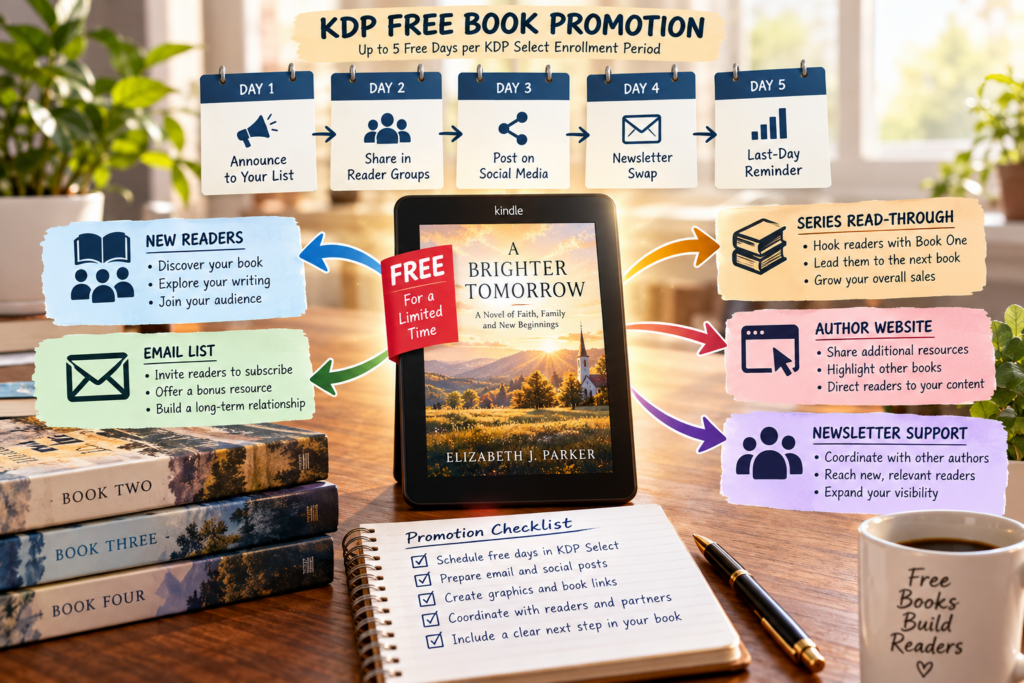
Making a Kindle eBook free can sound like the opposite of a publishing strategy.
Why deliberately remove the price from a book you invested time and money to produce?
Because immediate revenue is not always the objective of a promotion.
A KDP Free Book Promotion can introduce a title to new readers, create an entry point into a series, support another release, revive interest in an older book, or connect readers with a larger publishing catalog.
But making a book free does not automatically make the promotion effective.
Free is simply the offer.
The strategy comes from knowing why the book is being made free, what you want readers to do next, and how you will determine whether the promotion accomplished its purpose.
What Is a KDP Free Book Promotion?
A Free Book Promotion is a promotional option available for eligible Kindle eBooks enrolled in KDP Select.
KDP Select is Amazon’s 90-day program for Kindle eBooks. Enrollment makes the eBook available through Kindle Unlimited and provides access to promotional options that include Free Book Promotions and Kindle Countdown Deals.
During a Free Book Promotion, an eligible Kindle eBook can be offered at no charge for up to five days during the current KDP Select enrollment period.
Those days can be used:
- all at once
- one day at a time
- in shorter multi-day promotions
Unused promotional days do not carry over into the next enrollment period.
And because the Kindle eBook is free during the promotion, there is no royalty on those free units.
That makes the strategic question important:
What publishing objective is worth temporarily giving up the direct eBook royalty?
Free Book Promotions Apply to Kindle eBooks
The promotion applies to the eligible Kindle eBook edition.
It does not automatically make the paperback, hardcover, audiobook, or other editions free.
Those formats can remain available at their regular prices.
For publishers offering several formats of the same title, this creates an interesting possibility. The Kindle edition can serve as the promotional entry point without requiring every edition of the book to be discounted.
But the eBook must qualify for KDP Select.
KDP Select Requires Digital Exclusivity
Free Book Promotions are a KDP Select benefit, so the Kindle eBook must comply with the program’s exclusivity requirements during its 90-day enrollment period.
During that term, the digital edition is distributed through KDP and may also be distributed through public libraries under Amazon’s current rules.
Print, audio, video, and other non-digital formats can continue to be distributed elsewhere.
This tradeoff deserves consideration before enrollment.
A five-day free promotion may be useful, but it should not be the only reason a publisher accepts 90 days of digital exclusivity.
The larger question is whether KDP Select itself fits the book’s distribution strategy.
Public-Domain Books Are Not Eligible for KDP Select
This limitation is particularly relevant to Christian publishing because publishers sometimes produce new editions of historical Christian works.
Public-domain content is not eligible for KDP Select.
That means a straightforward public-domain edition cannot participate in a KDP Free Book Promotion.
Publishers working with classic sermons, theological works, historical devotionals, prayers, or other public-domain material should therefore evaluate promotional options before building a marketing strategy around KDP Select.
Being available as a Kindle eBook does not automatically make a title eligible for every Kindle promotional program.
You Get Up to Five Free Days per Enrollment Period
Each 90-day KDP Select enrollment period provides up to five Free Book Promotion days for an eligible title.
You do not have to use all five.
A one-day promotion might support a focused campaign.
A three-day promotion could provide more time for email and social outreach.
A five-day promotion might be appropriate when several promotional channels are being coordinated.
There is no reason to assume that longer is automatically better.
The number of days should follow the publishing objective.
Free Promotions and Countdown Deals Require a Choice
KDP Select provides two different publisher-controlled promotional approaches:
- Free Book Promotion
- Kindle Countdown Deal
For a particular KDP Select enrollment period, you choose which promotional type to use for that eBook. You cannot run both promotional types for the same title during that same enrollment term.
That makes the decision more meaningful.
A free promotion sacrifices direct eBook revenue during the promotional period in exchange for potentially broader reader acquisition.
A Countdown Deal retains a paid transaction at a temporarily reduced price.
Neither is inherently the correct choice.
They serve different strategies.
Start With the Objective, Not the Zero Price
Before scheduling a free promotion, decide what it is supposed to accomplish.
Possible objectives include:
- introducing the first book in a series
- attracting readers to an unfamiliar author or imprint
- bringing renewed attention to an older title
- supporting the release of another book
- encouraging discovery of related books
- growing a permission-based email audience
- supporting a seasonal campaign
- expanding awareness of a publishing brand or ministry
- testing reader interest in a title
The promotion should have a reason.
“It’s free because Amazon lets us make it free” is not a publishing strategy.
The objective determines everything that follows, including timing, promotional channels, calls to action, and measurement.
Series Publishing Creates a Clear Use Case
A series provides one of the easiest ways to understand the economics of free.
Suppose a publisher has a five-book Christian mystery series.
Book One is temporarily offered free.
A new reader discovers it, downloads it, reads it, and enjoys it.
Books Two through Five remain available at their regular prices.
In that situation, the free book functions as an entry point into a larger catalog.
The publisher is not evaluating the promotion solely by asking how much revenue Book One produced during those days. There was no direct royalty on the free copies.
The more useful question is whether the promotion contributed to readership and subsequent activity across the series.
That is a very different economic calculation.
Christian Fiction Can Use Free as a Discovery Tool
Christian fiction publishers can use a free period to introduce readers to more than a single title.
The reader may be discovering:
- a series
- recurring characters
- a fictional world
- an author
- an imprint
- a particular subgenre
Consider a Christian historical fiction series with several published titles.
Making the first book temporarily free while a later book is being promoted gives the offer a logical purpose:
Start the series free for a limited time.
That is stronger strategically than simply announcing:
This book is free.
The first message gives readers somewhere to go next.
Devotionals Need a Different Strategy
A devotional may not have the same read-through economics as a fiction series.
That does not mean free promotion has no value.
The downstream objective may instead involve:
- introducing readers to related devotionals
- supporting a Bible study
- growing a newsletter
- connecting readers with ministry resources
- supporting a seasonal campaign
- directing readers to relevant website content
- introducing a Christian publishing brand
For example, a devotional about grief could be part of a broader collection of Scripture reflections, prayer resources, articles, email content, and related books.
In that case, the free eBook becomes one entrance into a larger content ecosystem.
The economics are different from series fiction, but there can still be a measurable objective.
A Free Download Is Not the Same as a Reader
This distinction is critical.
People download books they never open.
They download books they intend to read later.
Some collect free books because there is no financial barrier to doing so.
Therefore, a high number of free units does not by itself prove that a promotion succeeded.
Amazon reports scheduled promotional downloads as Free Units-Promo, giving publishers a concrete measure of distribution during the campaign.
But that number is the beginning of the analysis, not the end.
The more useful question is:
What happened after the download?
Give Interested Readers a Logical Next Step
A book used for reader acquisition should make it easy for interested readers to continue their relationship with the author, publisher, or catalog.
Depending on the book, appropriate next steps might include:
- reading the next book in a series
- discovering another related title
- joining an email list
- subscribing to a newsletter
- visiting the publisher or author website
- accessing a companion resource
- exploring additional study materials
Do not overwhelm readers with competing calls to action.
One or two logical next steps are usually more useful than a page filled with unrelated offers.
Back matter becomes particularly important here.
A reader who reaches the end of the book has demonstrated far more engagement than someone who merely downloaded it.
Make the next step easy to find.
Connect Email Growth to Genuine Reader Value
A free promotion can introduce readers to a broader platform, but an email invitation should offer a meaningful reason to continue the relationship.
Suppose a devotional includes an invitation to receive a complementary seven-day prayer guide.
A reader finishes the devotional, visits the landing page, requests the resource, and joins the email list.
The publisher has now developed a direct, permission-based connection with someone interested in that subject.
That relationship may ultimately be more valuable than the revenue from a single eBook sale.
But the companion resource should genuinely complement the book.
Do not attach a generic giveaway merely because collecting email addresses is desirable.
The next step should make sense from the reader’s perspective.
Coordinate the Promotion With Existing Marketing
Do not assume Amazon will provide all the visibility a promotion needs.
A publisher can coordinate the free period with appropriate existing channels such as:
- social media
- publisher and author websites
- reader communities
- launch teams
- relevant partner newsletters
- ministry or organizational audiences
- appropriate cross-promotions
The Free Book Promotion provides the offer.
Marketing helps the intended audience discover that offer.
This is another reason to schedule strategically rather than making a book free without a supporting plan.
Respect Reader Communities
Free does not give publishers permission to ignore community rules.
Before promoting in Facebook groups, Reddit communities, forums, church groups, online reader communities, or similar spaces, understand the rules.
Some communities permit promotion only on designated days.
Some provide specific promotional threads.
Others prohibit self-promotion entirely.
Respect those restrictions.
A free book can still become unwanted spam when it is promoted in the wrong place or in the wrong way.
Cross-Promotion Can Expand Relevant Reach
Publishers and authors serving similar audiences may sometimes have opportunities to coordinate appropriate promotions.
These can include:
- newsletter swaps
- themed promotions
- reader events
- joint campaigns
- curated reading lists
Audience fit matters.
Several Christian historical fiction authors may serve overlapping readers. That does not mean every Christian book belongs in the same promotion.
A reader interested in biblical archaeology, children’s picture books, contemporary romance, and pastoral leadership is not automatically one interchangeable market merely because all four books are Christian.
Effective cross-promotion depends on reader relevance.
Be Careful With Paid Advertising
A publisher can use paid advertising to support a free promotion.
But remember what the advertising expenditure is purchasing.
It is not generating direct eBook revenue from the free download.
It is acquiring potential readers.
That means paid promotion needs a downstream objective.
For example:
Free Book One → Reader enjoys it → Reader purchases Book Two
or:
Free devotional → Reader joins newsletter → Reader discovers future books and resources
Without a meaningful next step, paid advertising for a free book can become expensive quickly.
The publisher should understand what a new reader is potentially worth before spending heavily to acquire one.
Be Careful With Third-Party Promotion Services
Publishers may also encounter outside services promising large numbers of downloads, exposure, ranking improvements, or financial returns.
Evaluate those services carefully.
Amazon places responsibility on publishers for promotional activity associated with their books and warns against tactics intended to manipulate Kindle publishing programs.
A large number of downloads is not valuable if the method used to generate them creates account risk or attracts readers who have no genuine interest in the book.
Be particularly cautious about guarantees.
Legitimate marketing can increase exposure.
It cannot guarantee how readers will behave afterward.
Free and Paid Rankings Are Different
One persistent misconception deserves clarification.
During a KDP Select Free Book Promotion, the Kindle eBook participates in Amazon’s free rankings rather than generating ordinary paid sales.
Amazon maintains separate Free and Paid Kindle bestseller lists.
Free promotional units do not count toward the Paid Books bestseller lists.
When the free period ends, the title returns to paid status, and Amazon indicates that its previous Paid rank influences its new rank when it re-enters the Paid categories.
Publishers should therefore avoid treating a large free-download number as a guaranteed path to a particular paid ranking afterward.
A free campaign can expose a title to more readers.
Some of those readers may later purchase other books.
But any subsequent sales increase should be measured, not promised.
Free Promotions Do Not Guarantee Reviews
Free readers are not required to review the book.
Many will never finish it.
Some will finish and never leave a review.
Others may voluntarily leave an honest review.
There is no dependable formula such as:
500 free downloads = 10 reviews
Reader behavior is not that predictable.
Do not evaluate a campaign using invented review percentages, and never condition access to the free book on leaving a review.
Reviews may be one result of increased readership.
They should not be treated as an entitlement.
Measure the Objective You Actually Set
Campaign measurement should begin with the reason the promotion exists.
If the objective is series discovery, relevant measurements might include:
- Free Units-Promo
- later sales of subsequent books
- Kindle Unlimited activity
- changes in broader series activity
If the objective is email growth, examine:
- landing-page visits
- new subscribers
- subscriber engagement
- subsequent interaction with relevant content
If the objective is broader awareness, you might examine:
- website traffic
- social engagement
- later sales
- reader responses
- activity across related titles
Downloads matter.
They simply do not tell the whole story.
Compare the Campaign With a Normal Baseline
Before the promotion begins, record what normally happens.
Depending on the objective, that could include:
- average daily sales
- Kindle Unlimited page reads
- sales of later books in a series
- email subscriber growth
- website visits
- landing-page traffic
Then examine what happens during and after the campaign.
Did Book Two sales change?
Did more people join the email list?
Did Kindle Unlimited activity increase?
Did website traffic rise and immediately disappear, or did some of those readers continue engaging?
Without a baseline, almost any movement can appear meaningful.
Measurement provides context.
There Is No Universal Success Threshold
There is no universal number of downloads, reviews, ranking positions, subscribers, or post-promotion sales that defines a successful KDP Free Book Promotion.
A niche theological work and a Christian romance series may behave very differently.
So may an established publisher and a new independent imprint.
Judge the promotion against the objective established before it began.
A small campaign that attracts 50 highly relevant readers could potentially be more useful to one publishing project than thousands of poorly matched downloads are to another.
Context matters.
Schedule the Promotion in Advance
Free Book Promotions must be scheduled before the desired start date.
Amazon currently requires scheduling at least one day in advance, and the earliest a Free Book Promotion can begin is the second day of the KDP Select enrollment period.
Promotions generally begin and end around midnight Pacific Time, so publishers coordinating email, advertising, or social campaigns should account for the timing.
Do not wait until the morning you want the promotion to begin.
Prepare the campaign beforehand.
That might include:
- social posts
- website content
- promotional graphics
- advertising
- partner outreach
- reader communications
The promotion should be one coordinated element of the campaign rather than an isolated price change.
Think About Timing Strategically
Publishing advice often turns timing into rigid rules:
Tuesday is best.
Weekends are best.
Three days are ideal.
Five days are always better.
Single-day promotions never work.
Those kinds of universal rules ignore the differences between books and audiences.
Timing should reflect factors such as:
- the intended audience
- email schedule
- release calendar
- series activity
- seasonal relevance
- available promotional partners
- campaign objective
Test what works for the actual catalog rather than adopting someone else’s rule as publishing law.
Seasonal Christian Books Can Benefit From Planned Timing
Christian publishing has natural seasonal opportunities.
Depending on the book, these may include:
- Advent
- Christmas
- Lent
- Easter
- Mother’s Day
- Father’s Day
- graduation
- back-to-school
- Thanksgiving
- New Year
A promotion connected to a genuine seasonal need can have a clearer purpose than an arbitrary free period.
For example, an Advent devotional promoted before Advent gives readers a reason to discover and begin using the book at the appropriate time.
The timing follows reader interest.
That is more useful than choosing promotional dates based on superstition about a particular day of the week.
Keep Faith-Based Promotional Messaging Honest
Christian publishing carries an additional responsibility in how books are presented.
A free Christian book does not require spiritual pressure.
Avoid promotional language implying that God specifically directed the reader to download a particular product or that obtaining the book represents a spiritual obligation.
Instead of:
God wants you to download this today.
Use straightforward language describing what the resource is and whom it may help:
The Kindle edition is free through Friday for readers looking for a Scripture-based devotional on hope during difficult seasons.
The second message communicates the offer without turning faith into a sales tactic.
That is both clearer and more respectful.
Frequently Asked Questions
How many free promotion days does KDP Select provide?
Eligible Kindle eBooks can be offered free for up to five days during each 90-day KDP Select enrollment period.
Do I have to use all five days at once?
No. The available days can be used together or divided into shorter promotions during the same enrollment period.
Can I use a Free Book Promotion and a Countdown Deal in the same KDP Select term?
No. For a particular enrollment period, the publisher chooses which of those two promotional types to use for that eBook.
Can I use a Free Book Promotion for a paperback or hardcover?
No. KDP Free Book Promotions apply to eligible Kindle eBooks. Other formats can remain available at their regular prices.
Can public-domain books use KDP Free Book Promotions?
Public-domain content is not eligible for KDP Select, so a public-domain title cannot use the KDP Select Free Book Promotion.
Do unused free days roll over?
No. Unused promotional days do not carry into the next KDP Select enrollment period.
Do free downloads guarantee more paid sales afterward?
No. A promotion can introduce a book to more readers, but subsequent sales depend on reader engagement, book quality, catalog structure, marketing, audience fit, and other factors.
Will free readers automatically leave reviews?
No. Readers may choose to review the book, but there is no guaranteed review rate.
Should Book One in a series be free?
It can be a useful promotional strategy when the economics of later books support reader acquisition through Book One. The decision should be based on the particular series rather than treated as a universal rule.
Where can I see how many copies were downloaded during the promotion?
KDP’s reporting includes a Free Units-Promo metric for units distributed through a scheduled KDP Select Free Book Promotion.
Make Free Part of a Larger Publishing Strategy
A KDP Free Book Promotion is not valuable merely because the price reaches zero.
Its value comes from what happens next.
A reader discovers the book.
Some readers open it.
Some continue reading.
Some finish.
And some of those readers may decide to explore another book, join an email list, visit a website, use a related resource, or become part of the publisher’s longer-term audience.
That is why the most important work happens before the promotion begins.
Define the objective.
Choose the right title.
Create a logical next step.
Coordinate the campaign.
Measure what happens afterward.
Free is the offer. The publishing strategy is what gives the offer a purpose.