KDP Print Formats Explained: Paperback, Hardcover, Trim Size and Binding
Choosing a KDP print format involves more than deciding between paperback and hardcover. Learn how binding, trim size, page count, paper, spine width, printing cost, and reader use should shape the finished book.
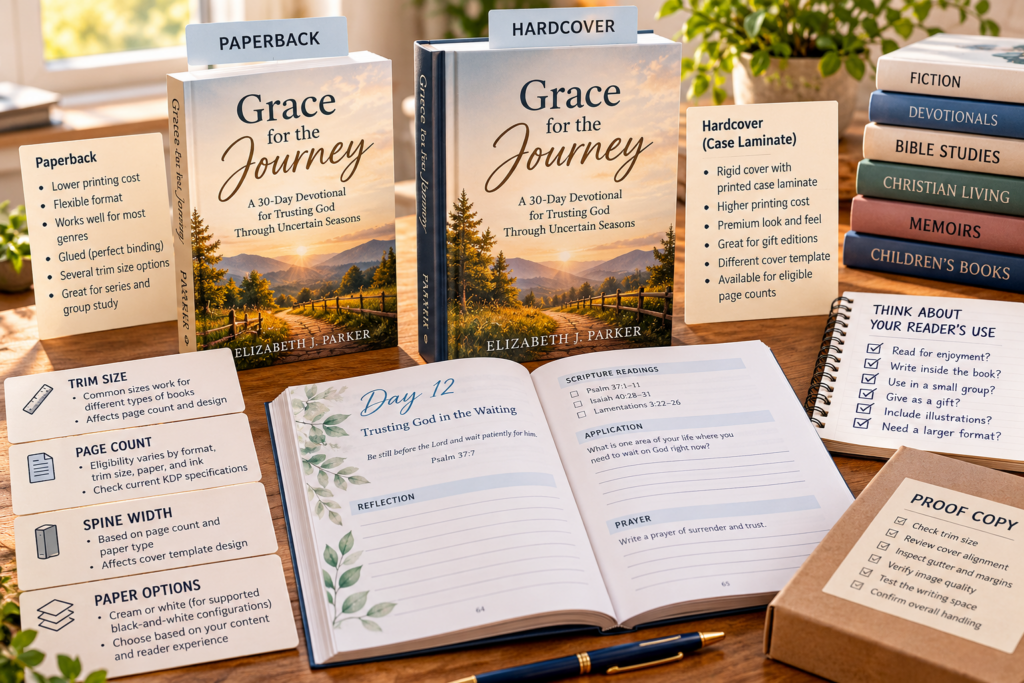
Choosing a KDP print format is more than deciding between paperback and hardcover.
The physical format affects printing cost, retail price, page-count eligibility, cover construction, spine width, trim-size availability, and the way the finished book feels and functions in the reader’s hands.
A novel designed for comfortable reading has different physical requirements from a Bible study filled with writing exercises. A children’s book may depend heavily on illustrations, while a workbook may need enough space for readers to write directly on the page.
The goal is not to choose the most impressive format.
It is to choose the format that best serves the book and its reader.
KDP Paperback Is the Most Flexible Starting Point
Paperback is the standard print format for many independent publishing projects.
It works particularly well for:
- fiction
- memoirs
- devotionals
- Christian living books
- Bible studies
- nonfiction
- study guides
- ministry resources
- many workbooks
KDP paperbacks use glued binding, commonly referred to as perfect binding.
The printed pages are gathered into a page block and attached along the spine, producing the familiar softcover format readers expect from commercial paperbacks.
For many publishing projects, paperback provides a practical combination of affordability, portability, and professional presentation.
Paperback Usually Keeps Production Costs Lower
Paperback printing generally costs less than hardcover production.
That gives publishers greater flexibility when establishing a retail price and determining the royalty available from each sale.
Lower production costs can be particularly useful for:
- series fiction
- books purchased in multiples
- church study groups
- ministry resources
- classroom materials
- lower-priced devotionals
- books intended for broad distribution
A paperback can provide a professional finished product without requiring the higher retail price generally associated with hardcover production.
But production cost should not be the only consideration.
The physical format still needs to support how the reader will use the book.
Paperback Does Not Naturally Lie Flat
Standard perfect-bound books are not designed to remain completely flat when opened.
That rarely creates a serious problem for novels, memoirs, or ordinary nonfiction.
It can matter considerably more for:
- journals
- workbooks
- Bible studies
- activity books
- cookbooks
- books designed for writing
If readers need both hands free while using the book, standard KDP binding may create limitations.
That does not necessarily mean the product should not be published through KDP.
It means the interior should be designed with the binding in mind.
Design Workbooks With the Gutter in Mind
Consider a Bible study containing reflection questions and writing exercises.
Readers may write directly in the book.
Important elements such as writing lines, diagrams, response boxes, Scripture callouts, tables, and illustrations should not be crowded against the inside gutter.
Give readers enough room to write comfortably without forcing the book unnaturally flat.
This is an important example of why book design and manufacturing decisions should not be separated.
A technically correct interior can still produce a frustrating physical product.
Hardcover Creates a More Substantial Edition
KDP also offers hardcover publishing for qualifying print books.
Hardcover may make sense when the publishing strategy calls for:
- a premium edition
- greater physical rigidity
- gift appeal
- stronger shelf presence
- an additional format for readers who prefer hardcover
This can be particularly attractive for certain Christian publishing projects, including:
- gift books
- family devotionals
- memoirs
- premium Bible studies
- ministry books
- special editions
- selected children’s titles
But hardcover should support the product strategy.
It should not be added simply because hardcover appears more prestigious.
Understand What KDP Hardcover Actually Is
KDP hardcover books use a case-laminate format.
The printed cover artwork is attached directly to the rigid cover boards.
This differs from a traditional hardcover produced with a removable dust jacket.
That distinction matters during production because hardcover artwork must be created according to the specifications and template for the hardcover edition.
A paperback cover production file should not simply be reused for the hardcover.
Hardcover Does Not Automatically Mean Sewn Binding
A rigid cover does not mean the book uses the traditional sewn-signature construction sometimes associated with premium offset-produced hardcovers.
Print-on-demand manufacturing and traditional offset book manufacturing can use different construction methods.
Publishers should therefore choose KDP hardcover for its available format, appearance, rigidity, and reader appeal rather than making unsupported assumptions about its binding construction.
The format should be evaluated based on what KDP actually produces.
Hardcover Costs More to Produce
A hardcover edition normally has a higher printing cost than its paperback equivalent.
That generally means the retail price must also be higher.
Before adding a hardcover edition, calculate whether the resulting retail price makes sense for the intended audience.
Ask:
Would the intended reader realistically pay this price for this particular book?
A premium devotional gift book may justify the increase.
A short introductory booklet may not.
The decision should be based on the economics and purpose of the actual publishing project.
Page Count Matters, but There Is No One Universal Limit
Page-count eligibility can depend on several production variables rather than one number applying to every KDP print book.
Relevant factors can include:
- trim size
- paperback or hardcover
- ink type
- paper choice
- bleed
- manufacturing specifications
Publishers should therefore confirm the current KDP requirements for the exact format being produced.
Do not design an entire book around a page-count limit remembered from an old article, video, or tutorial.
Production specifications can change, and different configurations can have different requirements.
Minimum Page Count Can Affect Short Books
Very short manuscripts can create another production issue.
A short devotional, children’s book, poetry collection, booklet, or specialty publication may fall below the requirements for a particular print configuration.
Do not add meaningless pages simply to force the book into a format.
Instead, consider whether the reader would genuinely benefit from additional material such as:
- reflection questions
- journaling pages
- discussion prompts
- prayers
- Scripture references
- author notes
- study resources
- bonus material
Additional pages should improve the book.
They should not exist simply to satisfy manufacturing requirements.
Trim Size Is Part of the Format Decision
Binding is only one component of the physical book.
Trim size can significantly affect both production and reader experience.
A traditional novel or memoir may work well in a compact trade size.
A Bible study may benefit from a larger page that provides room for questions and notes.
A workbook may require even more writing space.
Before choosing the trim size, consider:
- amount of text
- number of illustrations
- tables
- worksheets
- writing areas
- desired page count
- portability
- intended reader use
A larger trim size can reduce page count because more material fits on each page.
A smaller trim size can produce a thicker book from the same manuscript.
Neither is automatically better.
Page Count Changes Spine Width
Final page count directly affects the spine.
More pages generally create a thicker spine, while paper and production specifications also influence the dimensions required for the full cover.
That is why the final production cover should usually be completed after the interior is stable.
If you change the:
- trim size
- page count
- paper
- print configuration
you may need a new cover template.
Do not assume that the previous spine dimensions will still fit.
Very Thin Books Have Limited Spine Space
A thin paperback may not provide enough practical spine width for readable text.
Even when spine text is technically possible, it may appear cramped or be vulnerable to ordinary manufacturing variation.
Sometimes the cleaner design decision is to leave the spine without text.
Do not force a title, subtitle, publisher mark, author name, or decorative graphics into a space that cannot comfortably accommodate them.
Production limitations should influence the design rather than being treated as problems to disguise.
Paper Color Is Primarily a Reading and Design Choice
For supported black-and-white print configurations, paper options should be evaluated according to the content and intended reading experience.
Cream paper is commonly associated with text-heavy reading.
White paper may be particularly suitable for books containing:
- diagrams
- worksheets
- tables
- charts
- instructional material
But avoid simplistic rules such as fiction must use cream or nonfiction must use white.
Choose the paper that best supports the actual book.
Color Interiors Change the Economics
A book containing color illustrations, photographs, diagrams, or other visual material creates another important production decision.
Color printing costs more than black-and-white printing.
That can significantly change the retail price required for the book.
Before choosing a color interior, ask:
Does color materially improve the reader’s experience or understanding?
For some books, absolutely.
Illustrated children’s books, visual instruction, photography, charts, and other image-dependent content may genuinely require it.
For other projects, color may increase production cost without adding enough reader value.
The decision should begin with the content and reader rather than appearance alone.
Paperback and Hardcover Need Separate Cover Files
The same front-cover concept can often be adapted across formats.
The actual production file cannot simply be reused unchanged.
Paperback and hardcover templates account for differences in:
- dimensions
- spine measurements
- wrap areas
- bleed
- construction
Always build the final cover using the template for that exact edition.
This becomes especially important when a publisher adds a hardcover edition after the paperback has already been released.
The Interior May Also Need Review Between Formats
The manuscript content may remain identical between paperback and hardcover editions.
That does not mean the print experience will automatically be identical.
When adding another format, inspect:
- gutter
- margins
- chapter openings
- page numbers
- headers
- illustrations
- blank pages
- overall page balance
Changes in physical dimensions can affect how the interior feels even when the words remain unchanged.
Bible Studies Need Usable Writing Space
Christian publishers frequently produce Bible studies, study guides, devotional workbooks, and other resources that readers actively use rather than simply read.
These products require additional consideration.
Readers may need space to:
- answer questions
- write prayers
- record observations
- copy Scripture
- complete exercises
A compact trim size may reduce production costs while creating an unpleasant writing experience.
A slightly larger format may produce a far more useful book.
This is where reader experience should take priority over minimizing every production expense.
Devotionals Can Work Well in Several Formats
Devotionals offer considerable format flexibility.
A standard paperback may work well for:
- personal daily reading
- portability
- affordable gifting
- group distribution
Hardcover may be better suited to:
- premium gift editions
- family devotionals
- keepsake books
- seasonal gift products
A publisher may eventually offer both.
The two formats can serve different buyer preferences without changing the core content.
Christian Fiction Usually Favors Simplicity
For much Christian fiction, paperback remains a practical physical format.
Readers generally benefit from comfortable handling, reasonable pricing, and portability.
Hardcover can still be offered for readers who prefer premium editions or want to collect a series.
The hardcover can complement the paperback rather than automatically replacing it.
The important question remains whether the additional format serves a real publishing purpose.
Children’s Books Require Extra Format Planning
Children’s publishing deserves special attention because physical design can be central to the reading experience.
Consider:
- What age is the reader?
- Will the child hold the book independently?
- Are illustrations essential?
- Is the text large enough?
- Does the book need to withstand frequent handling?
- Does KDP offer the trim and print configuration the design requires?
Not every children’s book concept fits KDP’s available production options equally well.
Design the product around what the selected printing platform can actually manufacture.
Workbooks May Expose KDP’s Limitations
Standard perfect binding is not ideal for every workbook.
A workbook intended for extensive writing may benefit from a binding that opens flatter.
KDP does not provide every physical binding style available from specialty printers.
Some educational, instructional, and workbook products may be better suited to:
- spiral binding
- wire binding
- coil binding
If that physical experience is essential to the product, another production method may be more appropriate.
The correct publishing decision is not always to force the product into KDP.
Sometimes the manufacturing requirements should determine the platform.
Consider How the Reader Will Use the Book
This may be the most useful question in the entire format decision.
Will the reader hold the book while reading?
Paperback may work beautifully.
Will the book be given as a gift?
Hardcover may add perceived value.
Will the reader write extensively inside it?
Trim size, margins, gutter design, and binding become especially important.
Will the reader place the book beside them while completing exercises?
A binding that resists lying flat becomes more noticeable.
Will the book primarily present visual material?
Paper, ink, trim size, image reproduction, and printing cost become major considerations.
The reader’s behavior should influence the format.
Always Order a Physical Proof
A digital preview cannot reveal everything about a printed book.
Order and inspect a physical proof before approving the final edition.
Check:
- trim size
- cover alignment
- spine alignment
- gutter
- margins
- text size
- image quality
- paper appearance
- writing space
- page balance
- overall usability
Hold the book.
Read several pages.
Write in it if readers will be expected to write in it.
Examine the cover and spine from different angles.
A physical proof can reveal production problems that remain invisible on a monitor.
Frequently Asked Questions
What binding does KDP use for paperbacks?
KDP paperbacks use glued perfect binding rather than spiral, wire, or coil binding.
Does KDP offer hardcover books?
Yes. Eligible books can be published using KDP’s hardcover case-laminate format.
Does KDP offer dust jackets?
KDP hardcover production uses case-laminate covers rather than removable dust jackets.
Can I publish both paperback and hardcover editions?
Yes. When corresponding editions are set up appropriately, publishers can offer multiple available formats of the same title.
Should I choose paperback or hardcover?
Choose according to the audience, production cost, retail price, book type, and intended reader experience. Paperback is often a practical starting point, while hardcover can serve a premium or additional-edition strategy.
Is hardcover always more durable?
A rigid cover provides different physical protection than a paperback, but publishers should not assume that every hardcover uses premium traditional binding construction.
Does page count determine which format I can use?
Page count is one factor. Eligibility can also depend on trim size, ink, paper, bleed, and other production specifications.
Can KDP print spiral-bound workbooks?
Standard KDP print formats do not provide spiral, wire, or coil binding. If flat-opening behavior is essential to the product, another production method may be more suitable.
Should the hardcover use the same cover file as the paperback?
No. Each format requires a cover file built to the correct template and dimensions.
Do I really need a proof copy?
For a professional print edition, inspecting a physical proof is one of the most valuable quality-control steps before publication.
Choose the Format Around the Reader
Binding should never be an afterthought.
The physical format affects how readers experience a book every time they pick it up.
A paperback may provide the best combination of affordability and usability.
A hardcover may create a stronger premium or gift edition.
A larger trim size may transform a cramped Bible study into a useful workbook.
And sometimes a book that genuinely needs spiral or specialty binding belongs with a different printer.
Start with the reader.
Ask how the book will actually be used.
Then choose the physical format that supports that experience.