
Amazon KDP Low-Content Books: What Publishers Need to Know
Low-content books can include journals, planners, notebooks, and logbooks, but KDP treats them differently from conventional books. Learn the ISBN rules, distribution limitations, design considerations, publishing economics, and strategies publishers should understand before creating one.
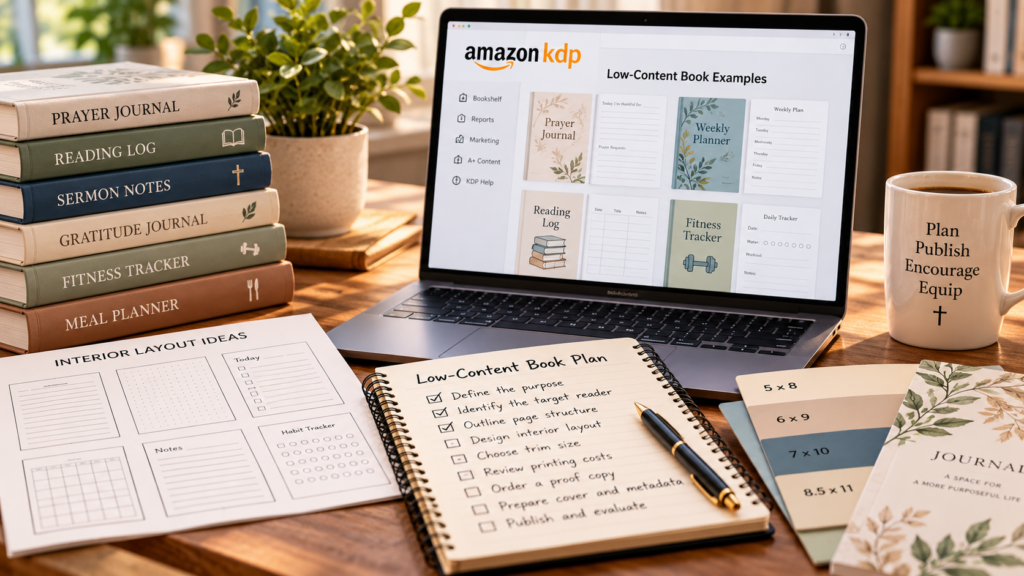
Low-content books are one of the most misunderstood categories in self-publishing.
They are often presented online as an easy way to build a large catalog quickly: create a notebook, repeat an interior template, design a cover, upload it to Amazon, and move on to the next title.
That approach misses the more important publishing question.
Does the book serve a useful purpose for a specific reader?
A prayer journal, reading log, fitness tracker, appointment book, sermon-notes journal, or specialized planner can be a legitimate publishing product. But simply filling a book with repeated pages does not automatically make it useful, distinctive, or commercially viable.
Amazon Kindle Direct Publishing also treats low-content books differently from conventional books in several important ways.
Before publishing one, it helps to understand exactly what KDP considers low-content, what publishing options are available, and how these books fit into a broader publishing strategy.
What Is a Low-Content Book on Amazon KDP?
Amazon defines low-content books as books with minimal or no content on the interior pages. They generally contain repetitive pages designed primarily to be completed by the purchaser.
Common examples include:
- notebooks
- planners
- diaries
- journals
- prompt journals
- log books
- score-card templates
- certain crafting templates
The important characteristic is not simply that the book contains fewer words.
It is that much of the book’s value comes from the structure provided for the reader to write, record, plan, track, or otherwise interact with the pages.
A weekly planner, for example, may repeat essentially the same layout dozens of times. A prayer journal might provide recurring spaces for Scripture, prayer requests, gratitude, and reflection.
Both can qualify as low-content books.
Not Every Activity Book Is a Low-Content Book
This distinction matters because the term “low-content” is often used too broadly.
Amazon does not generally classify books such as these as low-content:
- coloring books
- puzzle books
- children’s books
- nonfiction books
- textbooks
- manuals
- photography books
- sheet music
A children’s activity book containing puzzles, instructions, illustrations, and educational exercises may require relatively little conventional prose, but that does not automatically make it a low-content book.
Likewise, a guided workbook containing substantial original instruction and exercises may be better understood as a conventional book rather than a low-content product.
Publishers should classify the book according to what it actually contains rather than using “low-content” as a catch-all description.
Low-Content Publishing Is Still Product Development
The word “low” can be misleading.
Low-content refers to the amount and nature of the interior content. It does not mean low effort, low quality, or low value.
Consider a specialized planner.
A useful planner requires decisions about:
- page structure
- sequence
- writing space
- typography
- trim size
- recurring sections
- navigation
- usability
- printing
- binding
- cover design
The publisher still has to understand the person who will use it.
A generic lined notebook has very little built-in differentiation.
A carefully designed reading journal for a church book club, however, might include space for reading dates, important passages, discussion questions, personal observations, prayer applications, and meeting notes.
The amount of printed content may still be relatively small.
The usefulness of the product can be much greater.
KDP Does Not Provide Free ISBNs for Low-Content Books
This is one of the most important differences between low-content books and many conventional KDP print books.
KDP’s free ISBN option is not available for low-content books.
Instead, a publisher can generally choose between:
Publishing the low-content book without an ISBN
or
Supplying an ISBN the publisher obtained independently
That decision should be made before publication because ISBN strategy can affect how a publisher manages editions, imprint identity, distribution, and the broader catalog.
If you’re building a publishing business rather than experimenting with a single product, ISBN decisions deserve more consideration than simply choosing whichever option gets the book uploaded fastest.
What Happens If You Publish Without an ISBN?
KDP allows eligible low-content books to be published without an ISBN.
That can simplify production, but it comes with tradeoffs.
One significant limitation involves Amazon’s Read Sample feature. Low-content books published without an ISBN do not currently receive the standard Read Sample functionality.
That matters because the interior is often one of the most important selling points of a planner, journal, or logbook.
A cover can attract attention.
The interior demonstrates whether the product is actually useful.
Publishers who do not have the standard preview option can use A+ Content, where available, to show customers interior images and explain the product’s features.
For low-content books, showing the interior can be especially valuable.
Low-Content Books Are Not Eligible for Expanded Distribution
Publishers should also understand the distribution limitations before choosing this format.
KDP low-content books are not eligible for Expanded Distribution.
That means a publisher developing a product specifically for broader bookstore, library, or institutional distribution should consider whether a KDP low-content edition supports the intended distribution strategy.
This becomes particularly important for organizations.
Suppose a ministry develops a prayer journal intended primarily for direct promotion to its existing audience and Amazon customers. KDP print-on-demand may work well for that objective.
A publisher developing a product intended for widespread trade distribution may have different requirements.
The product should determine the distribution strategy, not the other way around.
KDP Series Are Not Available for Low-Content Books
Low-content books are also not currently eligible for KDP’s Series feature.
That does not prevent a publisher from creating related products with consistent branding.
A church could produce several coordinated journals.
An author might develop companion journals around different books.
A publisher could build a recognizable collection of planners or logs.
But publishers should not assume those books will receive the same KDP Series functionality available to eligible conventional books.
This is another reason to understand platform limitations before designing an entire publishing program around them.
Design the Interior Around a Real Use
The strongest low-content concepts generally begin with a use case rather than a page count.
Ask:
What is the reader trying to accomplish with this book?
A prayer journal might help someone develop a consistent prayer practice.
A garden log could help a gardener record planting dates, weather, varieties, problems, and harvest results.
A homeschool planner might help a parent coordinate subjects, assignments, attendance, and learning objectives.
A sermon-notes journal could help church members record Scripture references, key points, questions, applications, and prayer responses.
Once the purpose is clear, the interior becomes easier to design.
Every field should have a reason to exist.
Every repeated page should contribute to the user’s objective.
That is a stronger publishing philosophy than beginning with, “How can I fill 150 pages?”
Repetition Should Serve the Reader
Repeated pages are inherent to many low-content products.
The problem is not repetition.
The problem is meaningless repetition.
A daily journal may reasonably repeat the same page 90 times because the reader needs the same framework each day.
A project planner might need several different recurring layouts:
- project overview
- monthly planning
- weekly priorities
- task tracking
- notes
- progress review
The interior should reflect how the product will actually be used.
Adding pages solely to make a book thicker can increase printing costs without increasing reader value.
Trim Size Should Follow Function
A low-content book is a physical tool.
Its dimensions affect how it works.
A compact journal may be convenient to carry.
A large planner may provide more room for schedules and handwriting.
A logbook with detailed tables may need additional page width.
A guided journal intended for a nightstand may have different requirements from a field notebook designed to travel.
Rather than choosing a trim size simply because it is common on KDP, consider where the book will be used and how much writing space each page requires.
Test the Physical Book Before Selling It
Digital previews are useful, but they cannot completely reproduce the experience of holding and using a printed book.
Order and examine a physical proof before publication whenever practical.
Look at the book as a customer would.
Can you comfortably write near the binding?
Is the type large enough?
Are lines and boxes dark enough to see without overwhelming the page?
Does the page feel crowded?
Is there enough writing space?
Are recurring layouts aligned consistently?
Are page numbers necessary?
Does the cover reproduce as expected?
Are any elements too close to trim boundaries?
If the book contains tables, trackers, or forms, try actually using them.
A technically correct PDF can still produce an awkward physical product.
Printing Cost Should Influence the Design
Every additional page has potential economic consequences.
Print royalties depend partly on list price and printing cost. Page count, ink type, trim specifications, marketplace, and other production choices can affect those economics.
This is why publishers should not automatically make a low-content book longer simply to make it appear more substantial.
A larger book may cost more to manufacture.
Color interiors can change the economics significantly.
A larger trim size may affect production choices.
Hardcover and paperback editions may support different pricing expectations.
Before finalizing the interior, calculate the expected printing cost and estimated royalty at realistic list prices.
The book should work financially as well as visually.
Pricing Should Reflect the Product, Not Just the Page Count
Two journals with the same number of pages can provide very different value.
One might contain repeated blank lines.
Another might contain a carefully designed system for managing a specific activity.
That difference can affect how readers perceive the product.
Price should therefore consider:
- intended audience
- product purpose
- physical format
- printing cost
- comparable products
- perceived usefulness
- design quality
- broader publishing strategy
Do not assume that the lowest price will generate the most sales.
Likewise, do not assume that adding pages justifies a substantially higher price.
Pricing should make sense for both the customer and the publishing economics.
Templates Can Help, but Understand What You Own
Templates can speed up production, particularly when building repeated page structures.
But publishers need to understand the license attached to anything they use.
Before incorporating a purchased or downloaded template, graphic, font, illustration, photograph, or design element, determine whether the license permits commercial use in a book offered for sale.
Also consider differentiation.
If hundreds of publishers can purchase exactly the same journal interior and cover components, using those assets unchanged gives customers little reason to choose one version over another.
A template can be a production starting point.
It should not replace product development.
Avoid Copying Successful Books
Studying competing products can reveal useful information about a market.
It can show what formats exist, what customers appear to value, what problems are being addressed, and where an opportunity may exist.
That does not mean copying another publisher’s book.
Do not reproduce another publisher’s cover, interior design, illustrations, wording, or distinctive creative elements.
Instead, study the underlying reader need.
If existing products repeatedly receive complaints about insufficient writing space, confusing layouts, missing tracking fields, or awkward organization, those observations can inform a better original product.
Competition research should lead to better publishing decisions, not imitation.
AI Does Not Remove Publisher Responsibility
AI tools can assist with parts of a publishing workflow.
They might help brainstorm product concepts, organize information, generate preliminary design ideas, or accelerate certain production tasks.
But the publisher remains responsible for the finished product.
KDP currently requires publishers to disclose AI-generated text, images, or translations when applicable during the publishing process. AI-assisted content is treated differently under KDP’s current disclosure requirements.
More importantly, using AI does not remove responsibility for intellectual property, accuracy, quality, or customer experience.
A publishing workflow can become faster without becoming better.
The standard should remain the finished product.
Metadata Should Describe the Book Accurately
Low-content books still need accurate metadata.
The title, subtitle, description, keywords, categories, and cover should represent what the customer is actually purchasing.
Avoid turning metadata into a collection of unrelated search terms simply because those terms appear popular.
A specialized prayer journal should be positioned as the product it actually is.
A gardening log should describe its actual gardening features.
A teacher planner should reflect the audience and functionality built into the interior.
Good metadata helps the appropriate reader understand the book.
It should not attempt to make one generic product appear relevant to every possible audience.
Low-Content Publishing Can Support a Larger Catalog
Low-content products become especially interesting when they support existing intellectual property, audiences, or publishing programs.
An author with a nonfiction book might develop a companion reflection journal.
A devotional publisher could produce a prayer journal.
A Christian educator could create a Scripture-copying journal.
A church might develop a sermon-notes book.
A ministry could offer a structured gratitude and prayer tracker.
A cookbook publisher might create a meal-planning companion.
A gardening publisher could produce a seasonal garden log.
These products have something that a randomly selected generic notebook does not:
context.
They belong to a larger relationship between publisher and reader.
That can make low-content publishing less about producing isolated products and more about extending the usefulness of an existing catalog.
Low-Content Does Not Have to Mean Low Value
This is perhaps the most important distinction.
A book can contain relatively few printed words and still provide substantial value.
A beautifully designed prayer journal that someone uses every morning for a year may contain less original text than a short nonfiction book.
That does not make it less meaningful to the reader.
The value comes from what the product helps the person do.
This is especially relevant in Christian publishing.
A journal does not need to become a miniature devotional merely to justify its existence.
Sometimes the publisher’s role is to create thoughtful structure and then leave room for the reader’s own prayers, reflections, Scripture observations, and experiences.
The empty space is not necessarily missing content.
Sometimes it is the point.
When Does a Low-Content Book Make Strategic Sense?
Before creating one, ask several questions.
Who will use this?
Identify the reader more specifically than “people who like journals.”
What will they use it for?
The answer should describe an activity or outcome.
Why does this need to be a physical book?
Some tracking systems work better digitally. Others benefit enormously from handwriting and portability.
What makes the interior useful?
Identify the functionality rather than simply the appearance.
Does KDP support the distribution strategy?
Remember the limitations surrounding Expanded Distribution, Series, ISBNs, and previews.
Can the product support an appropriate retail price?
Calculate printing costs and royalties before committing to the final design.
Does this strengthen a larger publishing catalog?
A companion product connected to an established audience can have a clearer purpose than an unrelated journal created merely because journals are easy to produce.
If those questions have strong answers, the project may deserve further development.
Frequently Asked Questions
What does Amazon KDP consider a low-content book?
Low-content books generally contain minimal or no interior content and rely heavily on repetitive pages intended to be completed by the user. Examples include notebooks, planners, diaries, journals, prompt journals, logbooks, and certain template-based products.
Does KDP provide a free ISBN for low-content books?
No. KDP’s free ISBN option is not currently available for low-content books. Publishers can generally publish an eligible low-content book without an ISBN or provide their own ISBN.
Can a low-content book be published without an ISBN?
Yes. KDP currently allows eligible low-content books to be published without an ISBN.
Are low-content books eligible for Expanded Distribution?
No. KDP low-content books are not currently eligible for Expanded Distribution.
Can low-content books be added to a KDP Series?
No. KDP’s Series feature is not currently available for books designated as low-content.
Are coloring books considered low-content books?
Not generally under KDP’s current definition. Amazon distinguishes coloring books from the low-content category.
Are puzzle and activity books low-content?
Not necessarily. KDP does not generally classify puzzle books as low-content. Classification should reflect the actual content and structure of the book.
Should I order a proof of a low-content book?
It is a very good publishing practice. Low-content products depend heavily on physical usability, so reviewing the printed book can reveal problems that are difficult to judge from a PDF alone.
Can I use templates to create low-content books?
Yes, provided you have the necessary commercial rights to the template and any included assets. Templates should also be evaluated and adapted for the actual needs of the intended reader.
Can AI be used when creating a low-content book?
AI tools can be used within a publishing workflow, but publishers remain responsible for the finished product and must follow KDP’s current requirements concerning AI-generated content, intellectual property, and content standards.
Build a Product, Not Just Pages
Low-content publishing does not need to revolve around flooding Amazon with notebooks or chasing supposedly overlooked niches.
It can be genuine product publishing.
Start with a reader.
Identify something that person wants to record, organize, plan, practice, remember, or accomplish.
Design the interior around that purpose.
Test the physical product.
Understand the economics.
Know the KDP restrictions before publishing.
And consider how the book fits within the rest of your catalog.
The number of words inside a book does not determine its usefulness.
The value comes from what those pages enable the reader to do.