How Much Does It Cost to Publish a Book on Amazon KDP?
Amazon KDP does not charge an upfront publishing fee, but producing a professional book can still involve editing, design, formatting, ISBN, proof, software, and marketing expenses. Learn how to build a realistic publishing budget.
Publishing a book through Amazon Kindle Direct Publishing can technically cost nothing.
There is no fee to create a KDP account, upload an eligible book, or make it available for sale through Amazon. For print books, Amazon’s print-on-demand system also means publishers do not have to purchase a large inventory before publication.
But that does not mean producing a professional book costs nothing.
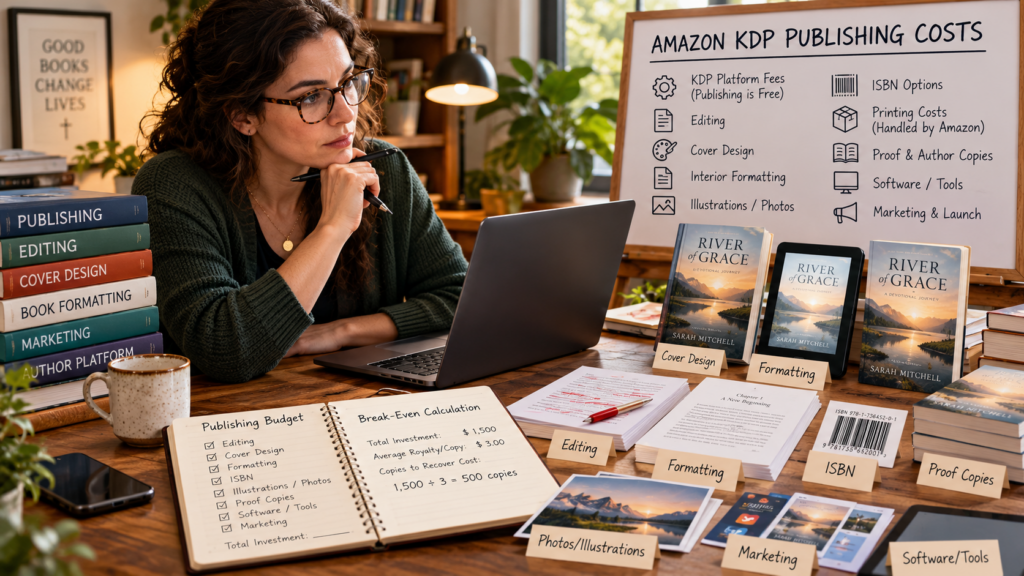
Editing, cover design, interior formatting, illustrations, ISBNs, proof copies, software, marketing, and other services can all become part of the publishing investment.
That distinction is essential:
KDP platform costs and book-production costs are not the same thing.
Understanding the difference makes it much easier to create a realistic publishing budget.
Does Amazon Charge to Publish a Book?
Amazon KDP does not charge an upfront publishing fee simply to upload and list an eligible Kindle eBook, paperback, or hardcover.
There is no required monthly KDP publishing subscription.
Instead, Amazon’s compensation comes primarily through the economics of each transaction.
For Kindle eBooks, the publisher receives the applicable royalty after Amazon’s portion and any applicable delivery costs or other adjustments.
For print books, Amazon calculates the royalty using the applicable royalty rate and subtracts printing costs.
That makes KDP fundamentally different from a publishing service that charges thousands of dollars simply to produce or distribute a book.
You can use KDP without paying Amazon an upfront publishing fee.
What you spend preparing the book is a separate question.
KDP Costs and Publisher Costs Are Different
Consider two publishers who each release a paperback through KDP.
Publisher A edits the manuscript, creates the cover, formats the interior, and handles the publishing setup personally.
Publisher B hires an editor, proofreader, cover designer, interior designer, and publishing specialist.
Both can publish through the same KDP platform.
Their KDP publishing fee is effectively the same: $0.
Their total investment in producing their books could be dramatically different.
This is why asking, “How much does KDP cost?” and asking, “How much does it cost to publish a professional book?” produce very different answers.
A useful publishing budget should account for both.
Editing Can Be a Major Publishing Expense
Editorial needs vary considerably from one manuscript to another.
A book may require several different types of editing.
Developmental editing examines the larger structure, organization, argument, pacing, character development, or effectiveness of the manuscript.
Line or copyediting focuses more closely on language, clarity, consistency, grammar, usage, and style.
Proofreading occurs near the end of production and looks for errors that remain after editing and formatting.
Not every project requires the same combination or intensity of services.
A 25,000-word devotional does not create the same editorial workload as a 100,000-word novel.
A Bible study developed through years of teaching may have different editorial needs from a first draft of a Christian nonfiction book.
Some publishers perform portions of the editorial process internally. Others hire specialists for every stage.
Rather than beginning with an arbitrary editing budget, determine what the manuscript actually needs and obtain estimates based on the manuscript’s length, condition, complexity, and required editorial level.
Cover Design Is a Production Cost, Not a KDP Fee
KDP does not require you to hire a professional cover designer.
It does require the uploaded cover to meet its technical specifications.
Those are different standards.
A technically acceptable cover can still be commercially ineffective.
Professional cover design may therefore become part of the publishing investment even though Amazon does not charge for it.
The requirements can also differ by format.
A Kindle eBook requires a digital cover.
A paperback requires a full print cover that accounts for the front, back, spine, trim dimensions, bleed, and other production specifications.
A hardcover introduces its own requirements.
Publishers should therefore budget for the actual formats they intend to release rather than thinking of “the cover” as a single universal file.
Interior Design and Formatting Depend on the Book
A straightforward text-based novel may require relatively simple interior formatting.
Other books can be considerably more complicated.
Consider:
- Bible study workbooks
- illustrated devotionals
- children’s books
- cookbooks
- educational books
- journals
- reference books
- books containing tables or charts
- books with photographs
- books containing extensive footnotes
- books with worksheets or activity pages
The more complex the interior, the more production work may be required.
Publishers can learn to format books themselves using appropriate software and KDP specifications, or they can hire someone to handle the work.
Again, the expense is not imposed by Amazon.
It results from the production requirements of the book.
ISBNs May or May Not Create an Additional Cost
Kindle eBooks published through KDP do not require an ISBN.
Print editions generally do.
KDP can provide a free ISBN for qualifying paperback and hardcover books. Publishers can also supply their own ISBN.
The choice has implications beyond cost.
A free KDP ISBN is available only for use with KDP and displays the imprint as Independently published.
A publisher using an ISBN registered to its own publishing business can identify its own imprint and use that ISBN for the same edition through other publishing services where appropriate.
That distinction may be relatively unimportant to someone publishing a single personal project.
It may matter considerably to someone establishing a publishing company or independent imprint.
Therefore, don’t ask only:
“Can I get an ISBN for free?”
Also ask:
“What role will this ISBN and imprint play in my larger publishing system?”
Illustrations and Specialty Content Can Change the Budget Dramatically
Some books require assets that conventional text-based books do not.
A children’s book may require original illustrations.
A cookbook may require food photography.
A historical work may require licensed photographs.
An educational book may need diagrams, maps, charts, or custom graphics.
A workbook may require professionally designed activity pages.
These costs can become significant because they involve more than simply preparing text for publication.
Rights also matter.
Publishers need to know whether photographs, illustrations, fonts, graphics, maps, quotations, or other third-party materials can legally be used in a commercial publication.
The more visually or technically complex the project becomes, the more important it is to establish these requirements before production begins.
Printing Costs Work Differently With KDP
One of KDP’s major advantages is print on demand.
With a traditional print run, a publisher might order hundreds or thousands of copies before knowing how many will sell.
That requires capital.
It also creates inventory.
With KDP print-on-demand publishing, Amazon can manufacture a copy when a customer orders it.
For normal customer sales, the publisher does not generally receive an invoice requiring payment for that copy’s manufacturing cost. Instead, printing cost is incorporated into the royalty calculation.
The basic concept is:
Royalty rate × applicable list price − printing cost = estimated royalty
Printing costs can vary according to factors such as page count, ink type, trim specifications, marketplace, and format.
This has an important consequence.
Printing cost is not merely a manufacturing issue.
It can affect the book’s minimum allowable price, royalty per copy, and overall financial viability.
Our Amazon KDP Book Pricing guide examines those relationships in greater detail.
Proof Copies and Author Copies Are Different
Print on demand eliminates the need to purchase inventory, but publishers may still spend money on physical copies.
Proof copies allow publishers to examine a book before publication.
That can be particularly valuable for checking:
- margins
- page alignment
- image reproduction
- color
- typography
- headers and footers
- page breaks
- cover placement
- spine appearance
- overall physical presentation
After publication, publishers may also order author copies.
These might be used for events, direct sales, reviewers, media contacts, churches, conferences, giveaways, or personal inventory.
Those copies, along with applicable shipping and taxes, should be included in the project budget when relevant.
They are real publishing expenses even though they are not KDP setup fees.
Software and Publishing Tools Can Add Costs
Independent publishers may use software for:
- writing
- editing
- book formatting
- graphic design
- image creation
- project management
- keyword research
- email marketing
- accounting
- file storage
- website management
Some tools are free.
Others require one-time purchases or recurring subscriptions.
A publisher does not need every available publishing tool.
The important budgeting principle is to distinguish between tools required for the current project and tools that are merely convenient.
For a publishing business producing multiple books, software expenses may eventually become operating expenses shared across the entire catalog rather than costs assigned entirely to one title.
Your Website and Author Platform Are Separate Investments
You do not need an author website to upload a book to KDP.
You do not need an email newsletter.
You do not need a social media following.
Those resources may still be strategically valuable.
A publisher building a long-term author brand or publishing company may invest in:
- domain registration
- website hosting
- website development
- email marketing
- newsletter software
- reader magnets
- direct-sales infrastructure
- branding
- content production
These should generally be viewed as publishing-business or audience-development expenses, rather than fees required to publish a book on Amazon.
That distinction becomes increasingly important as the publishing operation grows.
Marketing Costs Are Not the Same as Publishing Costs
Marketing can easily become one of the largest expenses associated with a book.
But it helps to separate two questions.
What did it cost to produce and publish the book?
and
What are we willing to invest in selling the book?
Marketing expenses might include:
- Amazon Advertising
- other paid advertising
- promotional services
- launch materials
- advance reader copies
- publicity
- email marketing
- social content
- book events
- conference materials
- promotional graphics
None of these expenses are required simply to upload a book to KDP.
They are investments intended to generate awareness, readership, or sales.
Separating production and marketing expenses makes it much easier to understand whether the book itself was expensive to produce or whether the publisher deliberately chose an aggressive marketing strategy.
Three Ways to Build a Publishing Budget
There is no universal amount that every author should spend.
A more useful approach is to decide how the work will be divided.
DIY-Heavy Publishing
The publisher handles most production tasks personally.
That might include editing, formatting, cover creation, metadata, and KDP setup.
Cash expenses can remain relatively low.
The tradeoff is time, skill, and learning.
“Free” work still consumes resources.
If a publisher spends 50 hours learning software and preparing an interior, those hours represent a real investment even if no invoice arrives.
Hybrid Publishing Production
The publisher handles areas in which they are competent and hires specialists for others.
For example, an author might prepare the manuscript, handle basic formatting, and manage KDP personally while hiring a professional editor and cover designer.
For many independent publishers, this approach offers a practical balance between cost and professional specialization.
Professional-Service Production
The publisher outsources most major production functions.
Editors, designers, illustrators, formatters, proofreaders, and other professionals handle their respective specialties.
This generally requires greater financial investment but reduces the amount of specialized production work the publisher must personally perform.
None of these models is automatically correct.
The right model depends on skills, budget, publishing objectives, product complexity, and available time.
Build the Budget Before Production Begins
One of the easiest ways to overspend is to make publishing decisions individually.
An editor is hired.
Then a designer.
Then illustrations are commissioned.
Then software is purchased.
Then proof copies arrive.
Then launch expenses begin.
Each individual expense may seem reasonable while the total investment goes unnoticed.
Instead, create the project budget before committing to major expenses.
A simple framework is:
Editorial
- Cover design
- Interior design and formatting
- Illustrations, photography, or graphics
- ISBNs
- Proof and author copies
- Project-specific software or tools
- Rights or licensing expenses
- Launch materials
= Production and launch investment
Then track marketing separately:
Advertising
- Promotional services
- Ongoing email or platform costs
- Events and publicity
= Marketing investment
Now you can see what the book actually requires.
Calculate How Many Copies Are Needed to Recover the Investment
A publishing budget becomes much more meaningful when compared with expected royalties.
Suppose a publisher invests:
$1,500
in editing, design, formatting, proof copies, and other production expenses.
If the book generates an average royalty of:
$3 per copy
then:
$1,500 ÷ $3 = 500 copies
Approximately 500 copies would be required to recover the initial $1,500 production investment, before considering ongoing expenses, taxes, returns, advertising, or other costs.
If the average royalty were $5:
$1,500 ÷ $5 = 300 copies
This does not predict how many copies the book will sell.
It does something more useful.
It reveals the economic relationship between investment and royalty.
That allows publishers to evaluate a project before spending the money.
Think About the Entire Catalog, Not Just One Book
For someone publishing a single title, almost every expense may appear to belong to that book.
A publishing business operates differently.
Some investments support multiple titles.
A website may support twenty books.
Publishing software may be used for an entire catalog.
A reusable interior template might reduce production time for future books.
An email list developed during one launch may support subsequent releases.
A strong publishing imprint can benefit every title that follows.
This does not mean spending more automatically creates a better publishing business.
It means the economics of one book and the economics of a publishing operation should not always be evaluated in exactly the same way.
Christian Publishing Can Have Different Financial Objectives
Financial sustainability matters in Christian publishing, but maximizing royalty per copy is not necessarily the only objective.
Consider a church producing a discipleship guide.
Affordability may be especially important.
A Christian educator producing a Bible study workbook may need enough margin to support continued curriculum development.
A novelist may be building a commercial readership across a series.
A ministry may intentionally subsidize a book because distribution supports its broader mission.
A Christian publisher may need revenue from successful titles to finance future books serving smaller audiences.
Each project can have a different financial purpose.
The publishing budget should reflect that purpose.
Good stewardship does not necessarily mean spending as little as possible.
It means understanding what is being spent, why it is being spent, and whether that investment supports the mission and economics of the project.
Frequently Asked Questions
Can you publish a book on Amazon KDP for free?
Yes. KDP does not charge an upfront fee simply to upload and publish an eligible book. Producing the manuscript, cover, interior, illustrations, and other professional components may still involve expenses.
Does Amazon charge for printing my paperback?
Printing costs are incorporated into the royalty calculation for normal customer sales. The printing cost is deducted when calculating the publisher’s royalty rather than requiring the publisher to purchase inventory in advance.
How much should I budget to publish my first book?
There is no universal amount. The appropriate budget depends on manuscript length and condition, editing requirements, cover needs, interior complexity, illustrations, formats, ISBN strategy, and how much work the publisher can competently perform.
Do I need to hire an editor?
KDP does not require publishers to hire professional editors. Editorial quality remains the publisher’s responsibility, however, and the level of editing required depends on the manuscript.
Do I need to pay for a book cover?
No. A publisher can create a cover independently as long as it meets KDP’s requirements. Professional design may nevertheless be a worthwhile production investment depending on the publisher’s skills and commercial objectives.
Do I need to buy an ISBN?
Not necessarily. Kindle eBooks do not require an ISBN through KDP. KDP can provide a free ISBN for qualifying paperback and hardcover editions, or publishers can supply an ISBN registered to them.
Does a free KDP ISBN make Amazon my publisher?
No. KDP’s free ISBN uses the imprint Independently published. Publishers who want their own registered imprint associated with the ISBN can obtain and use their own ISBN.
Is advertising required to publish on KDP?
No. Advertising is a marketing decision, not a requirement for publishing through KDP.
Should marketing be included in the cost of publishing a book?
For business planning, it is useful to track production costs and marketing investments separately. Both affect the project’s overall profitability, but they represent different publishing activities.
The Platform Can Be Free. Publishing Still Requires Resources.
The statement “You can publish a book on Amazon for free” is technically useful but financially incomplete.
Amazon KDP can remove several substantial barriers to publication.
You do not need to pay Amazon an upfront publishing fee.
You do not need to finance a conventional print run simply to make a paperback available.
You do not need warehouse space for hundreds of books.
But producing a professional book still requires work.
That work can be performed by you, by paid professionals, or through some combination of the two.
So instead of asking only:
“How much does it cost to publish on Amazon?”
Ask:
“What does this book need to become publication-ready, which of those tasks can I perform professionally, and what should I budget for the rest?”
That is the number that matters.